
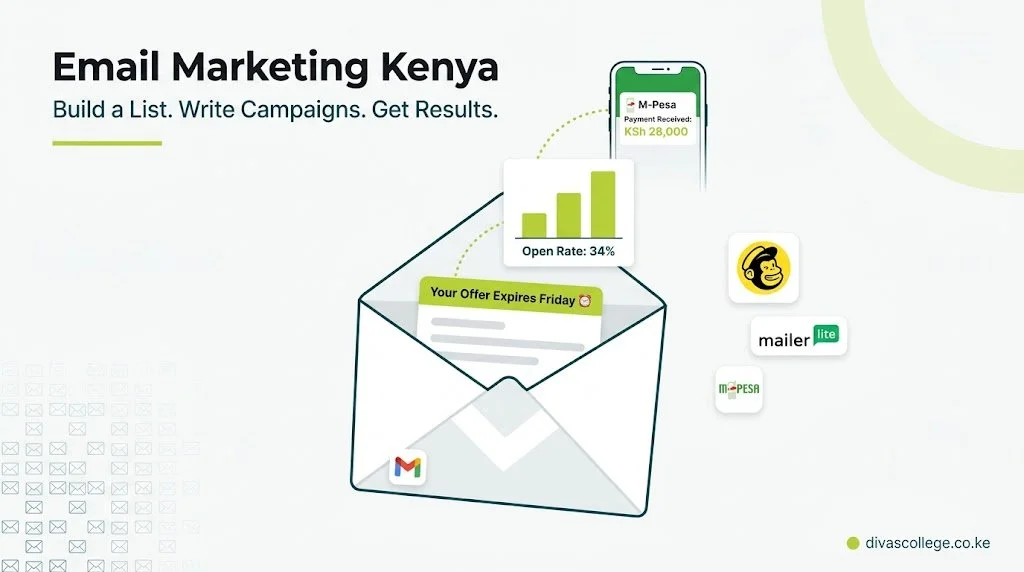
Most Kenyan businesses are missing their highest-ROI marketing channel. While the focus pours into Instagram posts, TikTok videos, and Facebook ads, email marketing in Kenya quietly delivers returns that social media simply cannot match. For every dollar spent on email marketing globally, the average return is between KSh 4,600 and KSh 5,400 at 2026 exchange rates, making it the highest-ROI digital marketing channel available to any business owner.
And yet most Kenyan SMEs are not doing it at all.
This guide changes that. Here is exactly how email marketing in Kenya works, which tools to use, how to build a list from scratch, and what types of campaigns actually convert in the Kenyan market.
Why Email Marketing in Kenya Works Better Than Most People Expect
Kenya has over 22 million internet users, with more than 90% of that access happening on mobile devices. Most of that mobile activity runs through Gmail. Your customers are checking their email every single day.
What makes email marketing in Kenya particularly powerful is the M-Pesa advantage. A customer who receives a promotional email, clicks through to a product or booking page, and pays via Lipa na M-Pesa has completed an entire purchase journey without leaving familiar platforms. That connection between email communication and M-Pesa payment is frictionless in a way that no other market can replicate.
Email also has one advantage no social media platform offers: you own your list. Facebook can change its algorithm. Instagram can reduce your reach. But your email list belongs to you permanently, regardless of what any platform decides.
For freelancers, the business case is equally strong. Email marketing in Kenya is a high-demand service that very few local marketers offer well. Businesses that understand its value will pay KSh 20,000 to KSh 60,000+ per month for a specialist who can manage their campaigns.
Step 1: Choose the Right Email Marketing Tool for Kenya
The first step in email marketing in Kenya is choosing a platform. The good news: the best options have generous free plans that cover the needs of most Kenyan beginners and small businesses.
Top email marketing tools for Kenyan businesses in 2026:
Mailchimp: the most widely used platform globally. Free for up to 500 subscribers and 1,000 emails per month. Excellent templates, simple drag-and-drop editor, and strong analytics. The best starting point for most Kenyan beginners.
Brevo (formerly Sendinblue): charges based on emails sent, not contact count. This makes it ideal for Kenyan businesses with large lists but low sending frequency. Free plan includes 300 emails per day.
MailerLite: clean interface, generous free plan (up to 1,000 subscribers and 12,000 emails per month), and excellent automation features. Highly recommended for bloggers and small business owners starting email marketing in Kenya for the first time.
ConvertKit: designed for content creators and bloggers. Free for up to 10,000 subscribers on their newsletter plan. Best for coaches, educators, and creators building audience-based businesses.
Which to choose: start with Mailchimp or MailerLite. Both are free, beginner-friendly, and have everything you need to launch your first email marketing campaign in Kenya within a day.

Step 2: Build Your Email List From Zero
An email list is the foundation of email marketing in Kenya. Without subscribers, there are no campaigns. Building a quality list (people who genuinely want to hear from you) takes intention and consistency, but it is entirely achievable from scratch.
The 5 most effective list-building methods for Kenyan businesses:
1. Website signup form with a lead magnet Offer something valuable in exchange for an email address. A free guide, a discount code, a checklist, a sample template, or exclusive content. Place the signup form prominently above the fold on your website homepage. A bakery might offer a “5 Kenyan cake recipes for special occasions” PDF. A digital marketer might offer a free “Social Media Calendar Template for Kenyan SMEs.”
2. WhatsApp list conversion Most Kenyan businesses have large WhatsApp customer lists. Send a broadcast message inviting your WhatsApp contacts to join your email list for exclusive updates, offers, or content. This converts an informal channel into a formal, more professional one.
3. Social media bio links Change your Instagram, Facebook, and LinkedIn bio links to point to a dedicated signup page. Post regularly about the value subscribers receive: “Join our email list for weekly tips on [your niche].”
4. In-person collection For physical businesses (salons, restaurants, schools, shops), collect email addresses at the point of service. A simple tablet or paper sign-up sheet with the ask: “Join our VIP list for exclusive offers.”
5. Content upgrades If you run a blog, offer a bonus resource related to each article in exchange for an email address. A reader who just read your article on graphic design pricing is highly likely to subscribe for a free pricing calculator template.
List quality over quantity: 200 subscribers who genuinely want your emails outperform 2,000 who were added without consent. Never purchase email lists. Purchased lists in Kenya produce spam complaints, damage your sender reputation, and deliver near-zero results.
Step 3: Write Email Campaigns That Get Opened and Clicked
The best email list in Kenya delivers nothing if your emails are not opened and acted on. Email marketing in Kenya follows the same principles as global best practice, with a few local nuances.
Subject lines that get opened:
The subject line determines whether your email is opened or ignored. Keep it under 50 characters for mobile display. Make it specific, not generic.
Weak: “Monthly Newsletter.” Strong: “3 clients in 30 days: here is exactly what I did.” Weak: “Special Offer Inside.” Strong: “Your 20% off expires Friday at midnight.”
Use numbers, questions, and specific outcomes in subject lines. Avoid ALL CAPS, excessive punctuation, and spam trigger words like “FREE!!!” which push emails into junk folders.
The four email campaign types every Kenyan business needs:

Welcome email: sent automatically when someone joins your list. Thank them, introduce your business, deliver the lead magnet if you offered one, and set expectations for what they will receive. Welcome emails in Kenya have the highest open rates of any campaign type.
Value email: pure education or entertainment with no direct sell. Share a useful tip, a case study, a resource, or an insight related to your audience’s interests. These build trust and keep your list engaged between promotional sends.
Promotional email: a direct offer with a clear call to action. A sale, a new service launch, a limited availability announcement, or a seasonal offer tied to Kenyan events (back to school, Easter, Diwali, Jamhuri Day). Always include one clear CTA button, not three competing links.
Re-engagement email: sent to subscribers who have not opened your emails in three to six months. Subject line: “Are you still interested in hearing from us?” Give them a reason to stay or an easy way to unsubscribe. A clean, engaged list always outperforms a large, unresponsive one.
Sending frequency for email marketing in Kenya: one to two emails per month is the right starting point for most Kenyan SMEs. This is enough to stay relevant without overwhelming your list. As your data grows and open rates are confirmed, you can test increasing to weekly sends for highly engaged segments.
Step 4: Track Your Results and Improve
Email marketing in Kenya is measurable in ways that social media simply is not. Every campaign shows you exactly who opened your email, who clicked, and who converted. Use this data consistently.
The key metrics to track:
Open rate: the percentage of subscribers who opened your email. A healthy open rate for email marketing in Kenya is 20% to 35%. Below 15% signals that your subject lines need work or your list needs cleaning.
Click-through rate (CTR): the percentage who clicked a link inside your email. A good CTR is 2% to 5%. Low CTR means your content or CTA is not compelling enough.
Unsubscribe rate: if more than 0.5% unsubscribe after each send, your content is misaligned with what your list expected when they signed up.
Conversion rate: how many email recipients completed the desired action (purchased, booked, enquired). This is the metric that ties directly to revenue.
What to do with the data: look at your best-performing email each month. What was the subject line? What was the content type? What time did you send it? Replicate what works. Drop what does not. Over three months of consistent analysis, your campaigns will improve dramatically.
Email Marketing in Kenya: A Practical Example

Here is what email marketing in Kenya looks like for a Kilifi-based beauty salon with 300 email subscribers:
Month 1: set up Mailchimp, add existing customer emails (with permission), send a welcome email with a 10% discount code for their next visit. Result: 28% open rate, 12 bookings from email directly.
Month 2: send a value email with “5 tips for protecting natural hair in Kenya’s coastal climate.” No sell. Pure value. Result: 34% open rate, strong replies and WhatsApp messages thanking them.
Month 3: promote a new hair treatment service with a limited-time introductory price. Result: 24% open rate, 8 new treatment bookings at KSh 3,500 each (KSh 28,000 revenue from one email).
That is email marketing in Kenya in practice: low cost, measurable, and compounding as the list grows.
Start Email Marketing in Kenya for Your Business or Clients
Email marketing in Kenya is both an essential business skill and a high-value freelance service. If you offer digital marketing services in Kenya, adding email campaign management to your packages increases your value and your monthly retainer rates significantly.
Want the digital marketing skills that make email work effectively? The Digital Marketing Course at Divas Technology College covers email marketing strategy, campaign writing, list building, analytics, and the full digital marketing toolkit, all in a practical, hands-on curriculum. Explore all our courses or enroll today.
You may also find these helpful:
- Social Media Content Strategy for Small Businesses in Kenya
- SEO for Beginners in Kenya: How to Rank on Google in 2026
- How to Earn with Digital Marketing Skills in Kenya
- Personal Branding in Kenya: Build an Online Presence That Attracts Opportunities
- How to Earn From a Blog in Kenya
Published by Divas Technology College – Practical Digital Skills Training in Kilifi, Kenya. divascollege.co.ke | info@divascollege.co.ke | +254 714 112 247


