
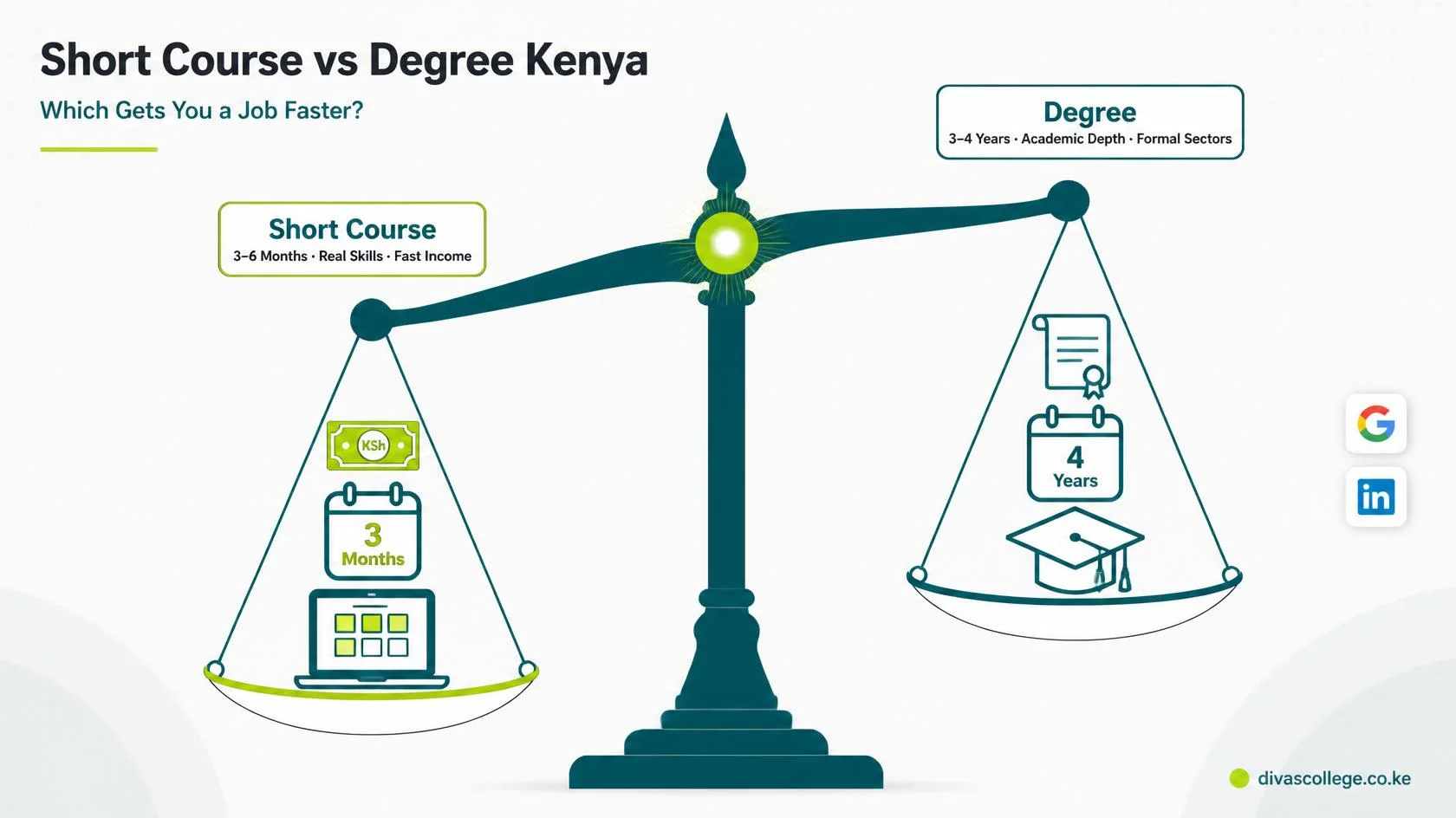
If you are weighing a short course vs degree in Kenya, you are asking the right question at exactly the right time. Kenya’s job market is shifting underneath the traditional education model, and the answer to which path gets you employed faster is no longer as straightforward as most parents and students assume.
This guide gives you an honest, data-backed comparison of short course vs degree in Kenya, specifically within the digital economy where the rules have changed the most.
What Is Actually Changing in Kenya’s Job Market?
Every year, over 800,000 students sit KCSE in Kenya. A fraction of them secure university places. The rest, and even many who do graduate, face a job market that is increasingly demanding something degrees alone cannot always provide: practical, immediately applicable digital skills.
BrighterMonday Kenya (2026) reported a clear shift in employer priorities: recruiters are now prioritising practical skills, digital fluency, and workplace readiness over academic credentials alone. The skills gap report they cited found that 51.21% of Kenyan youth lack the digital skills employers currently need.
Meanwhile, Kenya has seen 216% growth in online freelancers over five years, with over 1.2 million Kenyans now engaged in digital and digitally-enabled jobs. Remote work, freelancing platforms, and the digital economy are creating income paths that did not exist a decade ago, and most of them care about what you can do, not what certificate hangs on your wall.
That context is essential for understanding the short course vs degree in Kenya debate in 2026.
Short Course vs Degree in Kenya: A Direct Comparison
| Factor | Short Course | University Degree |
|---|---|---|
| Duration | 1 to 6 months | 3 to 4 years |
| Cost | KSh 5,000 to KSh 80,000 | KSh 200,000 to KSh 1,500,000+ |
| Time to first income | 1 to 6 months | 3 to 5 years (including job search) |
| Practical skills | High | Variable (depends on course) |
| Employer recognition | Growing rapidly | Still strong in some sectors |
| Freelance potential | Immediate | Delayed |
| Digital economy readiness | Very high | Depends on specific degree |
Where Short Courses Win in the Short Course vs Degree in Kenya Debate

Speed to income: a short course in digital marketing, graphic design, web design, or video editing takes three to six months to complete. Within that same period, a university student is still sitting in first-year lectures. For a Kenyan who needs income quickly, or who cannot afford four years without earning, the short course vs degree in Kenya calculation is clear: the short course delivers faster.
Practical, immediately applicable skills: universities teach theory. Short courses in digital skills teach tools. A graphic design short course graduate who can use Canva, Adobe Illustrator, and build a client portfolio is ready to earn from week one after finishing. A degree graduate who studied for four years without building a real portfolio often needs additional training before landing their first paying project.
Lower financial risk: a four-year degree in Kenya at a private university costs KSh 200,000 to KSh 1,500,000+. A short digital skills course costs KSh 5,000 to KSh 80,000. If the goal is a career in digital marketing, web design, or graphic design, the return on investment from the short course is measurably better. You spend less, start earning faster, and carry no student debt into your early career.
Digital economy compatibility: the digital economy rewards demonstrable skill. Clients on Fiverr, Upwork, and local businesses hiring freelancers do not ask for your degree transcript. They ask for your portfolio. Short course graduates who build strong portfolios consistently outcompete degree holders who lack practical experience in digital skills hiring environments.
Where Degrees Still Win in the Short Course vs Degree in Kenya Debate
Formal employment in structured sectors: if your goal is a corporate role in banking, law, medicine, engineering, civil service, or large institutional employers, a degree is still usually required for entry. The short course vs degree in Kenya equation tilts back toward the degree in these sectors because the hiring systems are structured around credentials.
Long-term salary ceiling in employed roles: in many Kenyan organizations, degree holders start at higher salary grades and advance faster through formal pay structures. A degree in computer science may open higher entry points at tech companies than a short course certification, particularly at multinationals.
Academic depth and breadth: degrees provide broader academic development: critical thinking, research skills, exposure to multiple disciplines, and the social networks built across four years on campus. For roles requiring deep academic knowledge, a degree remains the more complete preparation.
Post-graduate opportunities: masters degrees, research positions, and certain international professional programmes require an undergraduate degree as a prerequisite. If your ambitions include academia or senior research roles, the degree is the necessary foundation.
The Honest Answer to Short Course vs Degree in Kenya

Here is the truth most education guidance skips: it depends entirely on the career you are building.
For a career in Kenya’s digital economy (web design, graphic design, digital marketing, video editing, data analysis, UI/UX design, programming, content creation, and freelancing), a well-executed short course combined with a strong portfolio and consistent self-learning will outperform a degree in the same timeframe in almost every practical measure: time to first income, total income in the first two years, and flexibility of work arrangements.
For careers in medicine, law, engineering, teaching (formal sector), banking management tracks, and government roles, a degree is still the conventional and often legally required path.
The question to ask is not simply short course vs degree in Kenya. The question is: what specific career outcome do I want, and what is the most efficient path to that outcome from where I stand today?
Can You Do Both? The Most Powerful Path in 2026
Many of the highest-earning Kenyans in the digital economy in 2026 are degree holders who added practical short course skills on top of their academic foundation. A marketing degree graduate who adds a short digital marketing course and a Google Ads certification competes at a completely different level from one who relies on their degree alone.
Conversely, a short course graduate who pursues continued learning, industry certifications (Google, Meta, HubSpot), and eventually a professional diploma builds a profile that competes comfortably with degree holders in most digital economy hiring contexts.
The short course vs degree in Kenya debate is often a false binary. The most competitive professionals combine both: formal credentials for institutional credibility and practical skills for real-world performance.
What Short Courses Work Best in Kenya’s Digital Economy?
If the short course path makes sense for your goals, these are the areas with the strongest income and employment outcomes in Kenya in 2026:
Digital marketing (SEO, Google Ads, social media, content strategy). Graphic design (Canva, Adobe Illustrator, brand identity). Web design and development (WordPress, HTML/CSS, JavaScript). Video editing (DaVinci Resolve, Premiere Pro, CapCut). Data analysis (Excel, Python, Power BI, SQL). UI/UX design (Figma, user research, prototyping). Programming and software development (Python, JavaScript, PHP).
Each of these skills connects directly to freelancing income, remote work opportunities, and local employment in Kenya’s growing digital sector. Read our full guide: Top 10 Digital Skills Anyone Can Learn After High School in Kenya.

The Verdict
When the debate is short course vs degree in Kenya in the digital economy, short courses win on speed, cost, and practical income generation. Degrees win on formal sector access and institutional credibility.
Choose the path that serves the specific career you are building, not the one that satisfies the most people around you.
Thinking about a short digital skills course in Kenya? Divas Technology College offers practical, affordable short courses in digital marketing, graphic design, web design, video editing, data analysis, and more, all designed to get you client-ready and income-generating in months, not years. Explore all courses or enroll today.
You may also find these helpful:
- Top 10 Digital Skills Anyone Can Learn After High School in Kenya
- How to Start Freelancing in Kenya With No Experience
- How to Get a Remote Job in Kenya
- Which Programming Language Should You Learn First in Kenya?
- After KCSE, What Next? 7 Short Courses in Kilifi That Lead to Real Income
Published by Divas Technology College – Practical Digital Skills Training in Kilifi, Kenya. divascollege.co.ke | info@divascollege.co.ke | +254 714 112 247


